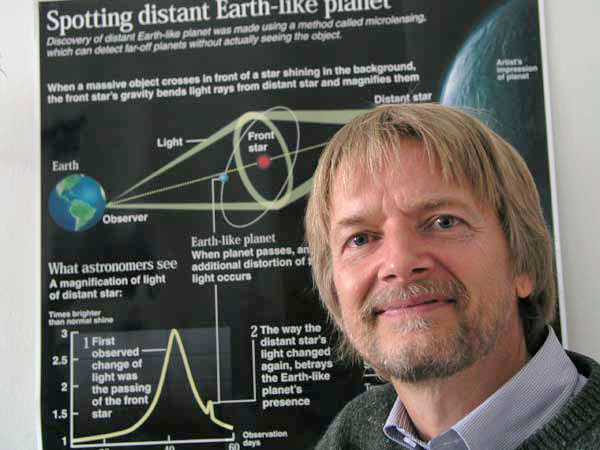
Email: uffegj@nbi.dk
Office phone: (+45) 35 32 59 98
Cellular phone: (+45) 61 30 66 40
Secretary: (+45) 35 32 59 96
Fax: (+45) 35 32 59 89
The postal address of the institute is:
Niels Bohr Institute, University of Copenhagen, Juliane Maries Vej 30, 2100 Copenhagen, Denmark
For historical reasons, this building of the NBI is called the Rockefeller Complex (see map: "Rockefeller_Komplekset").
My office is room 037, at the ground floor of the building to the left after entering the main entrance.
I am head of the group Astrophysics & Planetary Science and area leader ("område leder") for astronomy at the Niels Bohr Institute.
Exoplanets (planets around other stars):
Since 2002 I have been involved
in the search for extrasolar planets by use of the microlensing technique;
untill 2008 as part of the PLANET team,
and since 2008 as part of
the MiNDSTEp team, which I
started and organizes together with Martin Dominik.
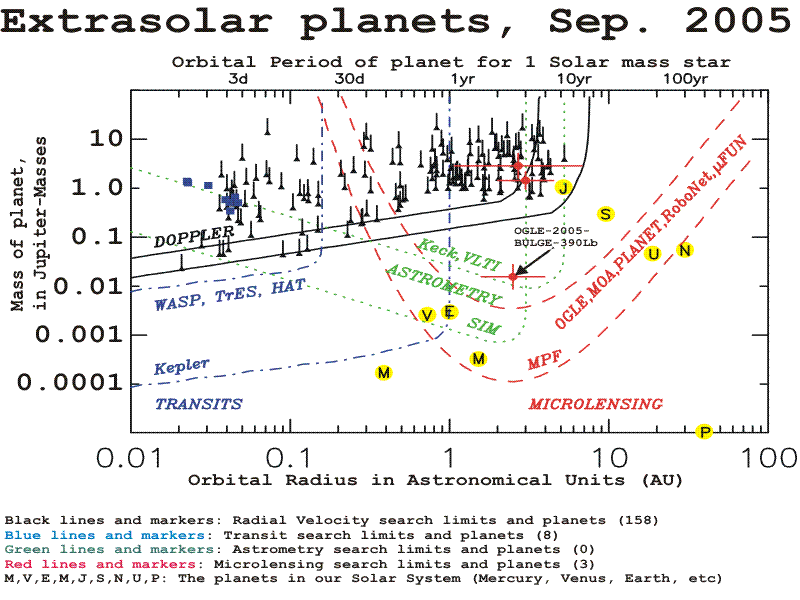
Microlensing is complementaty to the other techniques for finding exoplanets,
in the sense of being particular sensitive to planets in orbits similar to
those in our own solar system, say from 1 AU to 10 AU. With the present
set-up of telescopes and instrumentation the technique is sensitive down
to approximately Earth-mass planets (the smallest, as of 2014, being a
1.6 Earth-mass planet in a Venus-like orbit), but with the development of
the lucky imaging camera technology, microlensing should in principle be able
to identify planets as small as Mars or even smaller. The theory of stellar
microlensing was developed first by Einstein in 1936
(Science, vol.84, p.506-507),
and later suggested to be able to reveal planets orbiting the lensing stars by
Paczynski,
Gould, and others.
Several good descriptions about the theory of microlensing can be found on
the web, eg.
on the
planet-legacy pages,
the ARTEMiS pages,
or just simply the
Wiki- or
Scholar-pedia pages.
A short popular
article in Danish, written by one of my former students Kennet Harpsøe,
can be downloaded from the homepage of the journal Kvant.
In 1995 our team discovered, from the Danish telescope,
what was then by far the most
Earth-like exoplanet known. Although the planet is far from
identical to the Earth (for one it is estimated to have a surface temperature
of -200 Celcius degrees), it is Earth-like in the sense of
having a mass (5.5 Earth-masses) and an orbit (2.6 AU) much more resembling the
Earth than any
other exoplanets
that were known by then.
The results were published in
Nature, vol.439, p.437-440.
together with Nature's comments to the discovery on page 400-401 in the
same issue of the journal.
ESO's press-release
about the planet tells the story of the discovery, together with a short
animation and an interview with me .
Microlensing allows to observe exoplanets at very large distances, including
neareby other galaxies (although no planet outside our own Milky Way have
yet been ideentified). All of the microlensing planets discovered so far
have been identified due to the change in light of stars toward the centre of
our own Galaxy where the density is high enough for the phenomenon to have
a reasonable likelihood of happening. Typically a lensing star in this
direction will be in the conficuration that will allow the discovery of
orbiting planets once per almost a million years. Lensing observations is
therefore a team-work of many telescopes that notify each other
semi-automatically whenever a lensing anomaly is seen, to make sure that
more telescopes observe the lensing planet when it is visible. By 2014 the
total data-set of lensing curves contain approximately 50 events that seems
to be due to planets, of which approximately half have such a quality that
the parameters of the system has been well analyzed and published, including
OB12406Lb,
OB07368Lb,
OB05071Lb,
OB08310Lb,
OB09387Lb,
OB10073Lb,
OB110251Lb,
OB09266Lb and
OB09319Lb.
Since microlensing covers a parameter space not easily obtainable with any other
method, the most important result from the analysis is how the statistical
distribution of planetary masses and orbital distances are in this parameter
interval. As opposed to other methods, quite stringent statistical
conclusions can be drawn based on relatively few identified planets.
Two central statistical studies that our group has been part of,
conclude that there are
more planets than stars in our Galaxy,
that there
are many more small-mass planets than high-mass planets, and that
Jupiter-Saturn like planets in Jupiter-Saturn like orbits are relatively
rare.
This conclusion is in agreement with the statistical conclusions that
can be derived from the radial velocity and transit surveys of exoplanets.
In other words, Earth-like planets are common throughout the Milky Way,
while Jupiter-Saturn like planets are rare. From the philosophical point
of view of the Fermi paradox, one could ask whether this means that
Jupiter-Saturn like planets in Jupiter-Saturn like orbits are central
for the development of life on Earth-like planets further inside in
thr habitable zone in the system, as probably was the case in our own solar
system.
Microlensing search for exoplanets requires a dense stellar field (such that the chance of
two stars passing one another close enough in the sky is not negligble) and the search is
therefore concentrated in the direction toward the centre of the Milky Way.
The main activity (microlensing search for exoplanets) of our MiNDSTEp consortium is
therefore focused on the time where the centre of the Milky Way is visible in the
sky. The observations are therefore
best done from lattitude around -30 degrees on the Earth, where the Milky Way centre
passes zenith in the sky, and the best period of the year is from May to September, where
the Milky Way is visible during the longest part of the night. This is why the Danish
telescope at La Silla (at lattitude -29) and the period we have access to it (April to
October) is optimal for our research. However, even from La Silla the centre of the Galaxy
is not visible throughout the night, in particular not during "the wings" of our period, and
MiNDSTEp therefore have a number of other projects which we carry out during the time
when the centre of the Galaxy is not visible. These include:
* extended observations of transiting exoplanets, including:
WASP-80,
WASP-15/16,
GJ1214,
WASP-7,
WASP-18,
WASP-5,
and several others,
* development of the lucky imaging camera technology (which is essential for
pushing the microlensing exoplanet research toward detection of
planets with masses as small as the mass of the Earth, Mars, and even the Moon),
including test observations of
NGC6981 and detailed
studies of the accuracy of
photometry with EMCCDs,
* observations of objects in our own solar system, e.g. the
main-belt comet La Sagra,
and including also our recent discovery
of a ring around the centaur object
Chariklo,
by use of our newly developed lucky imaging camera technology at the danish telescope
(see also the press releases
from ESO and
from NBI
about this discovery)
* studies of globular clusters (among other things as a testbase for the development of
our lucky imaging camera), including
M30,
NGC6981,
M9,
* cosmological gravitational lensing (e.g. the quasars
HE0435 and
UM673 ),
and several other projects that we decide upon on an annual basis.
Stellar atmospheres and late stages of stellar evolution:
My early work on stellar atmospheres were on molecular opacities. When a molecule
increase in size from 2 atoms to 3 or more atoms, the number of possible transitions increase
substantially, because of the increase in modes and combinations between modes.
While a typical diatomic molecule has a few thousand vibrational-rotational transitions
of importance for the stellar spectrum and structure, the number of lines in just a
tri-atomic molecule are counted in the millions. One of my first findings was that
for polyatomic molecules, it is the veil of medium-strong lines that play the largest
role for the atmospheric structure. In hindsight this is quite obvious; a figurative analogue
could be the choice between sleeping covered in a thin blanket or a thick robe; the thinn
veil of medium-weak lines block the radiation, creating a much larger backwarming effect on the
atmosphere than the few strong lines would do, just as the blanket do to the heath of a
sleeping body. When introducing the opacity of HCN to cool carbon star giants, the size of
the model atmosphere expanded orders of magnitude, resulting in much better agreement with
observed spectra, and for example solving the seeming paradox of atmospheric models showing
carbon stars to be hydrogen poor, and it also quantified the huge effect logg (mass) had
on the overall spectrum of giant stars. Over the coming years I improved my early order-of-magnitude
estimates of the band-strengths (an early short conversation with Gerald Herzberg played an
important role in getting these estimates more or less correct)
to more detailed ab initio quantum chemical computations, in collaboration with
Jan Almlöf, Per Siegbahn and Mats Larsson during my stay in Sweden.
These and later studies include my work on opacities of
HCN ,
C3 ,
water ,
methane,
CIA
(collision induced absorption processes),
diamond dust,
CH,
CN,
TiO,
SiO,
and other molecules which will (hopefully) all be available as line lists on this web page
very soon again.
Reviews of the molecular data were summarised at several occasions
(including: 1,
2,
3).
Unfortunately most of my line lists disappeared from my public ftp site
a few years ago after a very unfortunate series of
almost simultaneous disk and computer crashes together with a misunderstood agreement
with the university about backups.
I have also promised myself to re-establish my line list
data base, hopefully very soon, making it again available from this web address.
In collaboration with
Åke Nordlund, Bengt Gustafson, Kjell Erikson, Hollis Johnson, Aleksandra Borysow, Josef Hron,
Susanne Höfner, and others, we investigated the effect on the stellar structure,
with implication for the late stages of small- and medium-mass stars.
These studies included reviews of the
stellar atmosphere modelling,
analysis of the effects of
spherical geometry,
hydrodynamics,
frequency dependence,
the sampling
-methods and
-optimisation,
tests of the models against spaceborne observations of
carbon- and
M-type giants, as well as ground-based wide spectral range
(e.g.
5000 AA to 2.5 mu_m)
comparisons of synthetic observed spectra, and analysis of white dwarf
atmospheres, and
evolution.
I'm still working in this field occasionally. In 2008 we published an updated version of the
MARCS code.
It is the intention that this will be followed by a series of more detailed papers
on various types of stellar atmospheres. In long term it is the hope to expand the
MARCS code to be able also to analyse sub-stellar objects with
cloud formation, and illuminated
stars
and hot (or cool) exoplanets.
The formation and evolution of the solar system.
A cornerstone in understanding how our solar system formed, is to understand what
should have gone different in order that our solar system would have become as
any of the many other exoplanetary system that has been identified in recent years.
In 2009 I participated in creating a centre of excellence,
StarPlan,
which theme could be expressed as:
"is our solar system unique -- and if so, is that then the reason that we are here?".
The centre is based on 4 multidisiplinary
entrances to the question: cosmochemical studies of
the interstellar environment where our solar system formed (through measurements
of early meteoritic material), numerical models of the disk formation phase,
sub-mm observations of solar systems under formation, and the study of exoplanetary
systems.
Although my main contribution to this study is in the field of exoplanets,
I have also been working on the meteoritic aspects, with studies of
interstellar grains in primitive meteorites, including a theory for the formation of
extrasolar diamond and SiC grains,
the absorption coefficient of the extracted extrasolar
diamonds and
silicon_carbide grains. By including these data in
atmospheric modelling it is in principle possible to trace the stellar origin of
the material that became the solar system.
I have also contributed to the solar system research with preditions and
speculations about what will happen to the Sun and the Earth during the
final phases of the evolution of the Sun.
A particular puzzling and interesting problem, in my oppinion, is how water originated on the Earth. It was too hot in the solar nebula for water to condense out of the nebula at the distance where the Earth assembled material for its formation. Therefore water must have come to Earth later. This problem is further supported by the fact that asteroids in the inner main belt are de-hydrated, while only asteroids (and meteorites) from the outer part of the belt contain water, indicating that there is a relatively sharp boundary at around 2.7 AU inside which water was not part of the originally assembled planets. Some years ago I had the great pleasure of being invited by Peter Apple to join his team of geologists on an expedition to the Isua region in Greenland . Isua is the only part of the Earth's sedimentary crust which is old enough to be contemporary with the late heavy bombardment -- the latest large scale assembly of cosmic material on Earth. During the Isua formation period 3.8 billion years ago, 2000 tons of cosmic material fel on each square meter of the Earth's surface. The samples we brought home from the expedition indicate that the bombarding objects were mainly comets, and if this conclusion is correct, they will have brought with them the same amount of water that is today present in the Earth's oceans. During the latest couple of years I have been working together with Hans Rickman to try to understand what consequences different scenarios of the late heavy bombardment would have for not only Earth and Moon, but for the other terrestrial planets too, in particular Mars. We will hopefully be able to publish these ideas soon in a regular scientific paper, but untill then a summary of a presentation I gave about these ideas at an international conference in Gdynia in 2014 is avbailable here.
This page is under re-construction. Due to a very unfortunate crash of the disks on two
independent computers together with a misunderstanding about the university's back up agreement,
the data dissappeared. Fortunately I have recovered most of the line lists now from various
collaborators that had downloaded a copy of the lists. The papers behind the computations
are described above, and the line lists will soon be available here again.
The instructions that describe the lists are available here for
CH,
C2,
TiO,
H2O,
and I try to add the description of the other molecules mentioned above together
with the lists as soon as I can.
Previous PhD students:
Kennet Harpsøe on the lucky imaging technique and microlensing
Christian Vinter on the search for exoplanets by use of the microlensing technique,
Juliana daSilva (co-advised with Luiz Vaz, Bel Horizonte, Brazil)
on external illumination in stellar and exoplanetary atmospherers,
Stefan Wolf (co-advised with Poul Hjort, DTU)
on Near-Earth asteroids; planning detection with the Gaia satellite.
Anja Andersen on dustformation in stars
Raul Jimenez on stellar evolution and the age of the Universe
Previous Master students:
Andrius Popovas on partition functions and opacity sampling methods,
Mads Sørensen, on the supernova rate in the solar neighbourhood
(co-adviced with Henrik Svendsmark, DTU Space),
Sanne Hardis, The transiting exoplanet GJ1214b,
Joris Vos, on eclipsing binary stars (co-supervising with Jens Viggo Clausen, NBI),
Mikkel Mathiasen, Photometry on microlensing events
Kristian Woller on stellar abundance analysis,
Maha Jasim on the formation of the solar system,
Sitte Larsson on the formation of the solar system and dust formation in the collapsing disk,
Tobias Hinse on orbital computation (resonances, migration, etc) of exoplanets.
Claus Nielsen on comets and the Earth's atmosphere,
Christian Vinter on the search for exoplanets by use of the microlensing technique,
Dorte E. Rasmussen on cool white dwarfs,
Steen E. Jørgensen on laser communication with satellite (co-supervising with Flemming Hansen, DSRI)
Jens Falkesgaard on chemical equilibrium computations,
Søren Rasmussen on stellar atmospheres,
Peter Pedersen on the initial stellar mass function,
Christiane Helling on molecular opacities (co-supervising with Erwin Sedlmayr in Berlin),
Anja Andersen on pre-solar dust grains in meteorites,
A popular description of some of our science results include:
A description of our discovery of a ring around the small Centaur asteroide Chariklo,
from NBI's, and
from ESO's home pages.
The discovery of the Earth-like exoplanet OB05390, from
ESO's text press release
and in the format of a video
animation and interview with me.
A sumary of our measurements of iridium abundances in samples collected at the 3.8 billion
years old Isua region in Greenland, indicating that the Earth and the Moon was bombarded with
2000 tons of
cometary material per square meter while Isua formed (in English and
in Danish ).
General popular talks
on the web include my short 2013 presentation in TV2 (Danskernes Akademi) about
the chances of finding life on other planets, presented in an
English version, and a
Danish version, my 1/2 hour presentation for teachers in 2010 at NBI about the
origin of water on the Earth, and a general and
longer presentation that I am particularly
happy with from the "Science and Coctails" arangement at Christiania in 2012.
Since 1995 I have had a fruitful collaboration with Bent Raymond Jørgensen
on several series of public lectures, starting with our series of 25
TV broadcastings about
natural science, history of science, philosophy, and its relation to religion. The
series was first filmed at NBI and broadcated in DR1 in 1995, and later we
made a technically better version in the television studios which was
broadcasted in 1996/97 (a total of 25 broadcastings).
The series of lectures
was issued in the form of a book with the titel
"Videnskaben_eller_Gud?"
("Science or God?") in 1996, with a revised second edition in 1998 and revised
and enlarged third edition in 2005.
Bent has an overview of
this and two later books
at his homepage.
I regularly publish popular articles in various journals, for example:
U.G.Jørgensen, Aktuel Naturvidenskab (nr 12, 2012, p.16-20) about habitable
exoplanets ("10 milliarder planeter som Jorden --
hvor er beboerne?).
U.G.Jørgensen, Berlingske. 22nd December 2012, about doomsday,
hvornår går Jorden så under?.
U.G.Jørgensen, Weekend Avisen, 13.January 2012, about our calculated statistics of habitable exoplanets,
hvor bliver de andre af?.
U.G.Jørgensen, Universitetets Almanak 2006 about exoplanets (2006).
U.G.Jørgensen, Naturens Verden about Tycho Brahe (NV, vol.84, nr.10, p26-31)
U.G.Jørgensen, Naturens Verden about the origin or the Earth's oceans (NV, vol.85, nr.2, p2-13),
U.G.Jørgensen, "Where does the elements come from?", Geologisk Museums
udstillingskatalog, 2006.
Haack, H., Jørgensen, U. G., Andersen, A., Bizzarro, M., Buchwald, V. F. (2006). Solsystemet - fra altings oprindelse til livets opståen. Geoviden, (3), 2-19.
Haack, H, Jørgensen, UG, Andersen, A, Bizzarro, M, Buchwald, VF 2006, 'Solsystemets opståen.' Geologisk Nyt, no. 5, pp. 10-18.
U.G.Jørgensen, Kvant about the Deep Impact collision with Comet Tempel (vol.16 nr.3, 2005, p.11,12,36),
U.G.Jørgensen, Aktuel Astronomi about exoplanets (AA, 2004 nr 2, p.16-19) "Exoplanetjagten,
U.G.Jørgensen, Kvant about the formation of solar systems (vol.15 nr.3, 2004, p.8-14),
"Er Solsystemet almindeligt blandt solsystemer?"
I'm in charge of the operation of the
Danish 1.54m telescope at ESO's La Silla observatory in Chile,
I lead the exoplanet part of the international
SONG
network of small robotic telescopes,
and I organize the
MiNDSTEp
microlensing search for exoplanets,
and I participated in the formation of the Nordic Astrobiology Network.
I participated in the
creation of the Centre of Excelence,
StarPlan
(Centre for Star and Planet Formation), with the aim of better
understanding the role of our own solar
system relative to other planetary systems in our Galaxy.
I was a member of ESO's OPC for a number of years during the late 1990'ies, and later member of ESO's user's committee. Since 2011 I have been the Danish scientific member of the ESO Council. Two of the most interesting issues we are discussing in Council during these years is ESO's conscruction of the world's largest optical telescope, the almost 40 meter mirror European ELT telescope, and the transformation of ESO from a European to a global organisation for astronomy.